"If you want a golden rule that will fit
everything, this is it: Have nothing in your houses
that you do not know to be useful or believe to be
beautiful."
designer, printer and socialist.
(cited from The Money Cafe)
"If you want a golden rule that will fit
everything, this is it: Have nothing in your houses
that you do not know to be useful or believe to be
beautiful."
The Tara Parker-Pope of the New York Times' Well blog has an article about how children learn better if they have time for play. It covered a number of studies about the effects of gym and recess on learning including this one:
At my son's school, at least one teacher uses denial of recess as a tool for disciplining the children in class. On that strategy, the article notes:
Participating in gym also helps:
Apparently just walking or being in a natural setting helps as well:
A small study of children with attention deficit hyperactivity disorder
last year found that walks outdoors appeared to improve scores on tests
of attention and concentration. Notably, children who took walks in
natural settings did better than those who walked in urban areas,
according to the report, published online in August in The Journal of
Attention Disorders. The researchers found that a dose of nature worked
as well as a dose of medication to improve concentration, or even
better.
Andrea Faber Taylor, a child environment and behavior researcher at the Landscape and Human Health Laboratory at the University of Illinois,
says other research suggests that all children, not just those with
attention problems, can benefit from spending time in nature during the
school day. In another study of children who live in public housing,
girls who had access to green courtyards scored better on concentration
tests than those who did not.
So here is where I get to share a teachable moment.
The Green Party takes a holistic approach to, well, everything. We tend to favor non-linear approaches in the policies we prescribe. Rather than view learning in a linear way, i.e. knowledge=hours of study, we recognize that life has diminishing returns. The more time or money that you put into something, say studying or consuming, the less you get out of it, i.e. knowledge or happiness. However, as the article shows, devoting more hours to play and fewer to studying helps children learn better.
As with knowledge, decreasing production and consumption for many of us, say by allowing people to work fewer hours, probably will increase their happiness. By devoting more time with family, friends, neighbors and health, and less with their TVs, cars and computers, people will be richer and live longer.
By having people with "higher skill jobs" do less, we create opportunities for those with "fewer skills" to learn and share in the work. We can eliminate or automate the drudgery jobs and design work that uses all of our faculties. We all end up better off if we distribute the work better, have less of it to begin with and make sure everyone benefits from the bounty this blue/green jewel of a planet is willing and able to share with us.
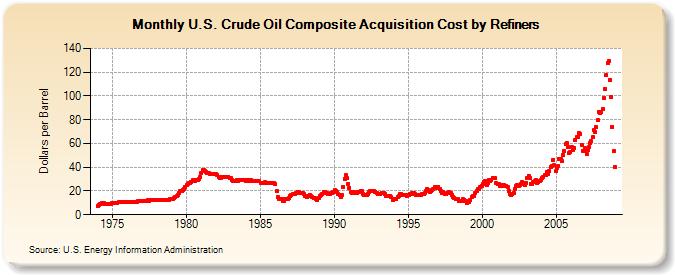
It looks like the non-OPEC drilling world probably hit peak oil in 2004. Conveniently, oil started rising rapidly then:
Also, it seems, OPEC production isn't significantly better than it was in the late 1970s:
Best to be investing in energy conservation and alternatives now. But corn ethanol and heating your home with wood just don't cut it.
Thanks to Tony Eriksen and Gail "the Actuary" Tverberg.
I meant to write up my 25 things about me, but other than writing down a few things in an unpublished blog post, didn't complete before the meme passed me by. Still I do have a few peculiar-funny stories from my past that I should write down to amuse kids and friends (Mel has heard them all). That will be another post.
However, the newest meme of navel gazing is to google "<your first name> needs" and write down what pops up. So here is my list as of midnight, EST, 2/24/2009:
Actually, that last one I added myself. Good night.
Latvia's center-right government fell today. It is the second to fall after Iceland.
The price of oil and other materials went through several years of rapid growth as the economy grew and several months of an even more rapid fall once the economy started to crash. Over at The Oil Drum, Phil Hart gave a pretty simple micro economics explanation of what happened and what might happen going forward.
His thesis relies on the idea that we have reached either a peak or the peak of oil production. However, given what we know of crude oil production in the last few years, the idea isn't far fetched.

As Phil points out, we could see more booms and busts. The busts prompt oil producers to rein in plans to expand oil production, leading to reduced production and higher prices. The higher prices then reduce output from the rest of the economy, causing the bust.
We may see this cycle in other commodities. Food production, under threat of increased desertification due to global warming, already happening in Australia and elsewhere (see Burning Questions), may exhibit a similar behavior. Dire conditions potentially.
Two of us met and gamed a Narn-Shadow meeting engagement.
Pictures up on flickr or you can view them as a slide show turn by turn.
Here is the description:
Shadows won initiative and the Narns started setting up first.
The G'Lan cruiser, Dag'Kar Missile Frigate, Ka'Toc Battle Destroyer held back while the T'Loths, Bin'Tak and the scout advanced.
The Shadows advanced at max on all fronts. However, the two scouts were
out of range and saw no action this turn. One Shadow cruiser
concentrated its fire on the vanguard T'Loth, while the other attacked
the Bin'Tak. Both Narn ships took significant damage. The Bin'Tak
remained in the battle, but the T'Loth was immobilized and one crew
point shy of having a skeleton crew.
The vanguard T'Loth attacked the closest Shadow scout, but wasn't able
to destroy the scout. The Bin'Tak and Dag'Kar loosed the energy mines
and other long range armament, but aside from damaging the scout
closest to the vanguard T'Loth, the Shadows took little damage.
The Narn scout reduced the stealth on a scout, but didn't much damage.
Turn 2
One Shadow cruiser attempted to move into a flanking position on the
Bin'Tak, while the other moved to engage the undamaged T'Loth and
G'Lan. The damaged scout flanked the immobile T'Loth. The other scout
played chicken with the Narn scout and ended up getting hit in the
rear, but no damage result owing to the Shadow scout's shields.
The G'Lan cruiser, and the mobile T'Loth moved up next to the ailing
T'Loth as did the Ka'Toc Battle Destroyer. The Dag'Kar Missile Frigate
held back while the Bin'Tak rotated in place to engage the Shadow
cruiser. Both traded blows with one another, with the Shadow cruiser
received scratches while the Bin'Tak took it on the chin, but still
focused it fire.
The damaged Shadow scout finally dispatched the immobile T'Loth while
the other Shadow cruiser concentrated on the G'Lan and gave it quite a
bruising including critical hits that left it immobilized.
The Dag'Kar and Ka'Toc attacked the Shadow scouts, but did not take either down.
The Narn fighters did engage the Shadow fighters, but with the local
advantage in numbers, the Shadows prevailed in the two dogfights.
Amazingly, a Shadow scout was able to avoid significant damage from a
cloud of Narn fighters.
Turn 3
One Shadow cruiser continued its attempt to flank the Bin'Tak, and
positioned itself just to the side of the Bin'Tak and out of range. The
other Shadow cruiser continued to engage the G'Lan.
The Shadow damaged scout turned its attention on the Ka'Toc and was
able to reduce it to a skeleton crew in the first shot. The other scout
focused its attentions on the G'Lan.
The Dag'Kar Missile Frigate, its energy mines fully loaded, attacked
the Shadow scout attacking the G'Lan. The Narn scout sailed behind the
Shadow ships. The remaining T'Loth contemplated opening a jump gate
next turn.
Over all, while the scenario was balanced points wise, the Shadows were
able to out maneuver the Narns and were well on their way to winning
the day. Both players felt that the Narns needed more ships to balance
the game out better.
I probably put to much time into reading the status messages, notes or what not that friends post on Facebook, Twitter, or their blogs (RSS feeds are your friends).
Part of my motivation is that several of my friends from bygones past died before I got back in touch. Indeed, in one case, I googled a friend to find that her only reference was her obituary from a few months before. While I know that it is just life, using these tools helps me, as Glen Daniels pointed out, to keep a finger in the lives of my friends whether we met 20 years ago or 2 months ago.
In someways I think I know more about some friends now than I did years ago. It is weird, fun and somewhat reassuring all in one
Paul Krugman writes:
He has likened our government's response to that of Japan during its "lost decade" in the 1990s after the crash of its property bubble and resulting financial crisis.
In a number of ways I agree. However, there are three things are very different between Japan then and the US now: two economic:
and one political:
This later point is the most important one.
While I have long maintained that the Democrats and Republicans are, in regards to the economy and capitalism, very similar, there are differences. After all, 36 of 41 Republican Senators supported the DeMint amendment to the stimulus bill which would have reduced federal government revenues by over $3 trillion and further enriched corporations and the wealthy at the expense of the rest of us.
If Obama cannot clean up the mess GW left us by 2010, or at least show enough progress, things could get very difficult for the congressional Democrats on election day.
Common Dreams has a great article
by Rebecca Solnit on the situation on Iceland (from TomDispatch). She
goes into more depth than other articles I have seen and provides some
useful analysis and history. I liked the characterization of Iceland
as a hedge fund and a country rolled into one.
There is now a Socialist & Left-Green coalition running the
government. Everyone seems to be blaise about the fact that the new PM
is an out lesbian, which is most gratifying. It also looks like the
Left-Green Party *may* come out on top in the April elections, though
we shall see. Back in October, Doug Henwood interviewed Ögmundur Jónasson, head of the Left Green delegation in the Icelandic parliament on his radio show. If you don't, you should subscribe to his newsletter, or at least read his blog.